All posts

The bandwagon effect is our habit of wanting something more because other people already want it. Popularity becomes a reason in itself. If a product looks like everyone is buying it, we assume it's good, and we don't want to be the one who missed it.
This page is for store owners. It covers where the idea comes from, 11 real examples from research and from brands, the point where it backfires, and how to use it on your own store without inventing anything. It's part of our wider guide to ecommerce psychology.
What the bandwagon effect is
The economist Harvey Leibenstein gave it a formal definition in 1950: "the extent to which the demand for a commodity is increased due to the fact that others are also consuming the same commodity." In the same paper he described its opposite, the snob effect: wanting something less because everyone has it. That's where the bandwagon stops working, and we'll come back to it.
Boost Your Conversion Instantly with Nudgify: Turn your website visitors into customers with real-time Social Proof and FOMO Nudges. Get Started Now →
The name is older. The usual story credits Dan Rice, a circus clown who invited the 1848 presidential candidate Zachary Taylor onto his circus bandwagon. Politicians soon wanted to be seen "jumping on the bandwagon" of whoever was winning.
Solomon Asch showed the psychology in the 1950s. People matched the length of a line, a task with an obvious answer. When everyone around them gave the same wrong answer, about three in four went along with the group at least once.
The bandwagon effect is closely tied to social proof, and the two get used as if they mean the same thing. A useful way to separate them: social proof is the signal (a review count, a "bestseller" tag, a live visitor count). The bandwagon effect is what happens when that signal snowballs. People join because others joined, which makes the number bigger, which makes more people join. If you want a gallery of the signals themselves, see our social proof examples.
11 bandwagon effect examples
Research that shows how it works
1. The hotel towel study
In 2008, Noah Goldstein, Robert Cialdini and Vladas Griskevicius tested towel-reuse cards in hotel rooms. The standard card asked guests to help the environment, and 35.1% reused their towels. A card saying most guests reuse their towels lifted that to 44.1%.
Increase Trust & Sales with Social Proof
Boost trust, engagement, and conversions with Social Proof — tailored for any industry and easy to integrate. Seamlessly manage client access with our team portal.


A second experiment made the group more specific. When the card said most guests who had stayed in this room reused their towels, reuse hit 49.3%, against 37.2% for the standard card.
What to copy: the closer the crowd is to the person reading, the stronger the pull. "Popular with runners" beats "popular". "Bestseller in London" beats "bestseller".
2. MusicLab: popularity snowballs, even by accident
In 2006, Matthew Salganik, Peter Dodds and Duncan Watts built an online music market with 48 songs by unknown bands and 14,341 participants. Some people saw how many times each song had been downloaded. Others didn't.
When people could see download counts, the popular songs got far more popular and the unpopular ones fell further behind. Success also became harder to predict. The same song could be a hit in one version of the market and ignored in another, depending on which songs got early downloads.
What to copy: a visible head start tends to stick. Put your genuine bestsellers in front of new visitors, and feature new products separately so they get a fair chance.
Brands that built the bandwagon into the product
3. McDonald's "Billions served"
For decades, McDonald's signs carried a running count of hamburgers sold. The number climbed until the signs read "Over 99 Billion", and McDonald's stopped updating it around April 1994.
Nobody chose a burger because of the 99th billion. The sign was a reminder that the crowd had already decided.
What to copy: a big, simple, cumulative number works at brand level. "12,000 orders shipped" on your homepage does the same job, if it's true.
4. Amazon "bought in past month"
Since 2023, many Amazon listings show a line like "1K+ bought in past month" under the title. Amazon started testing it in March 2023, and it was showing on listings widely by that August.
It's a bandwagon signal with a time window built in. It tells you how many bought recently, so the product is still current.
What to copy: recent beats total. A count with a window ("this week", "past month") feels alive in a way that an all-time total doesn't.
5. Etsy "Bestseller" and "in carts"
Etsy listings carry a "Bestseller" badge and messages like "In 20+ carts". The badge is relative: it marks items that sell well compared to others, not a fixed sales figure. Sellers on Etsy's own forums have pointed out a weakness in the cart count, though. Items can sit in carts for a long time, so the number can look bigger than real demand.
What to copy: a relative signal ("bestseller in this category") gives a small shop something to show even at low volume. And if you show a count, make sure it measures something recent and real.
6. Netflix Top 10
On February 24, 2020, Netflix added a Top 10 row to its home screen, updated daily, after testing it in Mexico and the UK for more than six months. A ranked list is a bandwagon signal you can't miss. It also solves a real problem: too much choice.
What to copy: a ranking does more than a count. "Top 5 this week" on a collection page helps people choose and nudges them toward what others chose.
7. Pebble Time on Kickstarter
In 2015, the Pebble Time smartwatch hit $1 million in pledges in 46 minutes, a Kickstarter record confirmed by Guinness World Records. It closed with $20,338,986 from 78,471 backers. The live funding bar and backer count were on the page the whole time, and every new backer made the next one more likely.
What to copy: progress toward a visible goal pulls people in. Preorders, launch counts and "X of 500 claimed" do the same job on a store.
Crazes where the crowd was the product
8. Tickle Me Elmo
Tyco planned for around 400,000 Tickle Me Elmo toys for the 1996 holidays. Then Rosie O'Donnell featured it on her show in October, shoppers saw other shoppers chasing it, and it sold more than a million by the end of December. A toy that cost under $30 in stores changed hands for hundreds of dollars.
What to copy: not the shortage. The lesson is that visible demand makes more demand, especially when people can see others trying and failing to get something. This is where the bandwagon meets scarcity marketing.
9. The ALS Ice Bucket Challenge
In the summer of 2014, people filmed themselves pouring ice water over their heads and nominated friends to do the same. The ALS Association says the challenge raised $115 million for it in 2014. Each video showed that people you know were doing it, then asked you directly to join.
What to copy: make joining visible. Customer photos, tagged posts and "share your order" prompts let each buyer recruit the next one.
10. Wordle
According to The New York Times, 90 people played Wordle on November 1, 2021. Just over two months later, more than 300,000 played in a day. The game had no share feature until mid-December. Then it added the grid of green, yellow and grey squares, and social feeds filled with them. The New York Times bought the game on January 31, 2022.
What to copy: the grid showed you that people were playing, without spoiling the answer. A good bandwagon signal is easy to share and makes others curious.
11. The Stanley Quencher
Stanley had made vacuum flasks for more than a century. Then a 40-ounce tumbler went viral on TikTok, where the #StanleyTumbler tag passed 900 million views. CNBC reported Stanley's revenue grew from $73 million in 2019 to $402 million in 2022, with 2023 projected to top $750 million.
What to copy: you can't manufacture a TikTok craze. You can make sure the people already talking about your product are visible on your site, through reviews, photos and real purchase activity.
When the bandwagon works against you
Telling people that lots of others do the wrong thing
Cialdini's team tested signs in Petrified Forest National Park, where visitors take pieces of petrified wood. A sign saying many past visitors had removed wood led to more theft (7.92% of pieces taken) than a sign that simply asked people not to (1.67%). Telling people "everyone does it" made it normal.
On a store, the same mistake looks like "Most shoppers abandon their cart, don't be one of them!" You've just told people that leaving is what everyone does.
Small numbers
"2 people viewed this today" is a bandwagon in reverse. It tells the visitor that almost nobody is interested. Hide counts below a sensible minimum, or use a longer time window.
The snob effect
Some buyers want what others don't have. If you sell limited runs or luxury goods, "10,000 sold" can hurt. Lean on scarcity and exclusivity instead.
Fake numbers
This is the big one. The 2019 Princeton study Dark Patterns at Scale (Mathur et al.) found 313 activity notifications, the "someone just bought" kind, across about 11,000 shopping sites. Twenty-nine of them, on 20 sites, were deceptive, and most of those were generated at random. The same paper notes that a Shopify plugin called Sales Pop was temporarily removed from Shopify for letting stores enter made-up sales.
Regulators have caught up. In August 2024 the US FTC finalised a rule banning fake reviews and testimonials, which also bans buying or selling fake indicators of social media influence, like bot followers or views. Our guide to fake social proof covers the risks in more detail. The short version: if shoppers spot one fake number, they stop believing the real ones.
How to use the bandwagon effect on your store
Show real activity, on the page where the decision happens
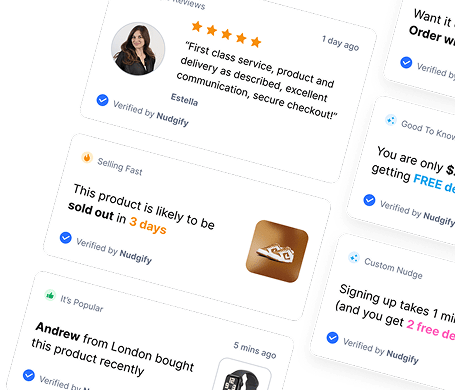
The product page is where the "is anyone else buying this?" question gets asked. A popularity nudge answers it with real data. It counts actual views of that product from your own traffic, shows how many people viewed it and when, and lets you set a minimum so it stays hidden until enough people have looked. If a product passes 100 views in your window, it shows "more than 100 people" rather than an oddly precise number.
Pick the window that's true and strong
If a product gets 60 views a week but 8 a day, show the week. Amazon's "past month" works because it's honest about the window. Don't stretch it so far that the number means nothing.
Make the crowd specific
The towel study's best result came from "guests in this room". On a store that could be a category ("bestseller in running shoes"), a place ("popular in Manchester") or a type of customer, as long as your data supports it.
Rank, don't just count
A bestseller tag or a top 10 on a collection page gives every store, however small, something true to say. One product is always selling best.
Let buyers bring the next buyer
Share prompts, customer photos and review requests make the crowd visible to the next visitor.
Pair it with scarcity, carefully
Popularity and low stock reinforce each other: "lots of people want this" plus "there aren't many left" is the Tickle Me Elmo formula. Both numbers have to be real. Popularity also has a cousin in loss aversion, the fear of missing out on something everyone else has. We cover that side in our loss aversion examples.
Bandwagon effect FAQ
What is the bandwagon effect in simple terms?
The bandwagon effect is the tendency to want something more because lots of other people already have it or want it. The popularity itself becomes a reason to choose. The economist Harvey Leibenstein named it in 1950 as demand that rises because others are consuming the same thing.
What is the difference between the bandwagon effect and social proof?
Social proof is the signal, such as a review count, a bestseller tag or a live visitor count. The bandwagon effect is what happens when that signal snowballs. People join because others joined, which makes the number bigger, which makes more people join.
Is using the bandwagon effect in marketing manipulative?
Not when the numbers are real. Showing genuine sales, views or rankings gives shoppers useful information about what other people chose. It becomes manipulation when the numbers are invented. A 2019 Princeton study found fake purchase notifications on 20 shopping sites, and the US FTC banned fake reviews and bought social media indicators in August 2024.
How can a small store use the bandwagon effect with low traffic?
Pick the time window and the scope where your numbers are strongest. A product with 40 views this week can show that, even if today's number is small. Rank products within a category so something is always the bestseller, and hide counts below a minimum so you never show a number that looks empty.

Increase your sales and sign-ups by up
to 15% from $9/mo. only with our Social Proof & FOMO App
Add to Shopify