All posts

Loss aversion is the finding that losing something hurts more than gaining the same thing feels good. Losing $10 stings more than finding $10 pleases. Shoppers don't weigh a discount and a fee of the same size equally, and that changes how you should price, ship and word almost everything on a store.
This page is for store owners. It covers where the idea comes from, 10 real examples from research and from brands, where it backfires, and how to use it on your own store without tricking anyone. It's part of our wider guide to ecommerce psychology.
What loss aversion is
Daniel Kahneman and Amos Tversky put it in one line in their 1979 paper on prospect theory: "losses loom larger than gains." In a 1992 follow-up they estimated that a loss weighs about 2.25 times as much as a gain of the same size. Later studies put the average a little lower, closer to two, but the direction has held up well.
Boost Your Conversion Instantly with Nudgify: Turn your website visitors into customers with real-time Social Proof and FOMO Nudges. Get Started Now →
Two related ideas show up in the examples below:
- The endowment effect. Once something is yours, giving it up feels like a loss, so you value it more than you would have paid for it.
- Framing. The same outcome described as a loss ("you'll lose $5") pulls harder than when it's described as a missed gain ("you could save $5").
10 loss aversion examples
Research that shows how strong it is
1. The mug experiment
In a 1990 study, Kahneman, Jack Knetsch and Richard Thaler gave coffee mugs to half a group of students and asked them what they'd sell for. The other half were asked what they'd pay. Median sellers wanted $7.12. Median buyers offered $2.87. Same mug, same room, minutes apart. Owning it more than doubled its value.
What to copy: anything that makes the shopper feel they already have the product (trying it, customising it, putting it in a cart) raises what it's worth to them.
2. "Cash discount", never "card surcharge"
Thaler noticed early on that when card companies allowed stores to charge different prices for cash and card, the industry wanted the difference described as a cash discount, not a credit card surcharge. The Nobel committee used this example when Thaler won in 2017. A surcharge is a loss. A discount you don't take is only a missed gain, and people shrug at those.
Increase Trust & Sales with Social Proof
Boost trust, engagement, and conversions with Social Proof — tailored for any industry and easy to integrate. Seamlessly manage client access with our team portal.


What to copy: describe your prices so the customer never "pays extra". "Members save 10%" lands softer than "non-members pay 10% more", even when the maths is identical.
3. The 5-cent bag tax
In 2012, Montgomery County, Maryland, started charging 5 cents for disposable shopping bags. Tatiana Homonoff studied the result and found disposable bag use fell by over 40 percentage points. In the same research, stores that gave a 5-cent bonus for bringing your own bag saw almost no change.
Five cents either way. As a fee, it changed behaviour. As a reward, it barely registered.
What to copy: small costs you can avoid are more motivating than small rewards you can earn. That's the whole logic of a free shipping threshold.
4. Teachers who might have to give the money back
Roland Fryer, Steven Levitt, John List and Sally Sadoff ran a study with 150 teachers in Chicago Heights in 2010-11. Some got a bonus at the end of the year if their students improved. Others got the money up front and had to return it if their students didn't. The up-front group's students gained 0.2 to 0.4 standard deviations in maths. The end-of-year bonus had no significant effect.
What to copy: giving something first and letting people keep it is stronger than promising it later. Keep that in mind for the discount and free gift examples below.
Shipping and checkout
5. The surprise cost at checkout
Baymard Institute's checkout research found that 40% of US shoppers who abandoned a checkout (leaving out people who were only browsing) did so because extra costs like shipping, tax or fees were too high. It's the top reason by a wide margin. The next, slow delivery, was 20%.
The cost isn't new information the shopper weighs calmly. It shows up after they've mentally committed to a price, so it reads as money taken away.
What to copy: show shipping costs, or the free shipping rule, before checkout. On the product page, in the cart, anywhere but the last step.
6. Amazon France and the one-franc shipping fee
Dan Ariely tells this story in Predictably Irrational. When Amazon introduced free shipping on qualifying orders, sales jumped everywhere except France. The French site had charged one franc, a few cents, instead of zero. Once shipping was made truly free in France too, sales there rose like everywhere else.
A tiny fee is still a loss. Free is a different category in people's heads.
What to copy: if you can absorb shipping above a threshold, make it zero, not "just $1".
7. Free shipping thresholds
Amazon has moved its free shipping minimum for non-Prime US customers several times, from $35 to $49 in 2016, down to $25 in 2017, and back up to $35 in 2023. The minimum moves. The mechanism never changes. Shoppers add items to avoid paying for delivery, because a fee you can dodge pulls harder than a saving you could earn.
Shopify supports this directly: in your shipping settings you can offer free shipping and "enter the minimum amount for an order to qualify for free shipping."
What to copy: set a threshold a bit above your average order value, and tell people how close they are.
8. Ticketmaster's checkout timer
Ticketmaster limits how long you can hold tickets before finishing your purchase, and shows a timer at the top of each checkout page. Once the seats are in your basket, they feel like yours. The timer isn't telling you that you might miss out. It's telling you that you're about to lose something you already have.
What to copy: a held item or a held price feels owned. If you reserve stock in a cart, saying so is honest and effective. Inventing a timer that isn't connected to anything is not. Our guide to scarcity marketing covers where timers cross the line.
Owning before buying
9. Warby Parker Home Try-On
Warby Parker lets you pick five frames to try at home for five days, free, including return shipping. It removes the loss of buying glasses that look wrong. It also hands you five pairs to live with, and the endowment effect from the mug study does the rest. Sending one pair back is easy. Sending all five back means losing something.
What to copy: samples, try-before-you-buy and generous trial periods let the product become the customer's before the money moves.
10. Zappos and 365-day returns
Zappos advertises "FREE 365 Day Returns and Exchanges!" The biggest fear in buying shoes online is losing money on a pair that doesn't fit. Zappos takes that loss off the table. Once the shoes are in your house, the same loss aversion works in Zappos' favour: returning them now feels like giving something up.
What to copy: your returns policy is a loss aversion tool. Put it near the add-to-cart button, not only in the footer.
Keeping what you've built
Not every example has to involve money. Duolingo's streak counter is pure loss aversion: miss a day and the number resets. Duolingo says learners who reach a 7-day streak are 3.6 times more likely to finish their course. When it let learners bank two Streak Freezes to protect a streak, daily active learners rose 0.38%. Loyalty points that expire work the same way, which is why programmes tell you about the points you're about to lose, not the ones you've earned.
When loss aversion backfires
Making leaving painful
In June 2023 the FTC sued Amazon over its Prime cancellation process, which Amazon internally called "Iliad", after Homer's long epic. The flow made people click through screen after screen of what they'd lose before they could leave. In September 2025 Amazon agreed to a $2.5 billion settlement: a $1 billion civil penalty and $1.5 billion in refunds. Reminding people what they'll lose is fine. Building a maze out of it is not.
Shaming people for saying no
The 2019 Princeton study Dark Patterns at Scale found 169 examples of "confirmshaming" on shopping sites, mostly email popups where the decline button said things like "No thanks, I like paying full price" or "No thanks, I hate saving money". It frames saying no as a loss, and most people read it as rude. It also tells them you don't trust your own offer.
Losses that aren't real
A fake deadline, a timer that resets, or a "your discount expires in 10 minutes" that doesn't expire are all invented losses. Shoppers who notice once stop believing the rest of your site. Every loss you mention should be one the customer would actually suffer.
Loss framing on everything
If every banner warns about missing out, none of them registers. Save loss framing for the moments where something really is at stake: a shipping fee, a real end date, stock that's running out.
How to use loss aversion on your store
Turn shipping into a goal, not a fee
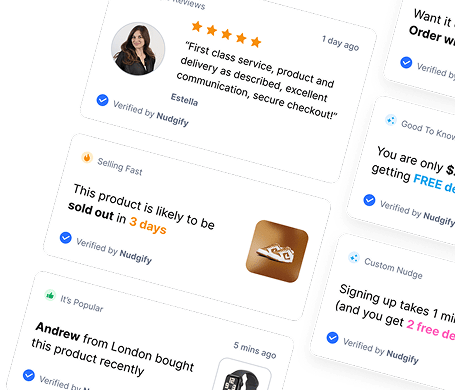
Tell shoppers where they stand. A free delivery nudge reads the live cart value and changes its message as the cart grows: "FREE delivery when you spend over $25" on an empty cart, then "You are only $12 away from getting FREE delivery", then "Congratulations! You are eligible for FREE delivery". The fee becomes something the shopper can avoid, which is exactly what the bag tax and Amazon threshold examples show people will work to do.
Give the discount first
The teacher study suggests that giving something up front beats promising it later. A discount nudge lets shoppers apply your store's discount code to their cart with one tick, so the saving is already theirs before checkout. Taking it away would mean abandoning a cart with a discount in it, and that's a loss. Use a real code with a real end date.
Let people own it before they pay
Free returns, try-on, samples and trial periods turn the product into something the shopper already has. Then the endowment effect works for you.
Name the loss plainly, and only when it's true
"Free delivery ends Sunday" is honest loss framing if it does end Sunday. "Only 3 left" is honest if you have three. Pair these with real activity: seeing that other people are buying makes missing out feel more real. That's the overlap between loss aversion and social proof, and you'll find formats for it in our social proof examples. The popularity side, wanting what everyone else wants, is covered in our bandwagon effect examples.
Describe what customers keep, not what you take
"Members save 10%" beats "non-members pay more". "Your order ships free" beats "no shipping charge applied". Frame around the thing the customer holds onto.
Loss aversion FAQ
What is loss aversion in simple terms?
Loss aversion means losing something feels worse than gaining the same thing feels good. Losing $10 hurts more than finding $10 pleases. Daniel Kahneman and Amos Tversky described it in 1979 as part of prospect theory, and later estimated losses weigh roughly twice as much as equal gains.
What is an example of loss aversion in marketing?
Free shipping is the most common one. A shipping fee feels like a loss added at the end, and Baymard Institute found 40% of US shoppers who abandoned a checkout did so because extra costs like shipping, tax or fees were too high. Free trials, generous return policies and expiring rewards points all use loss aversion too.
What is the difference between loss aversion and FOMO?
Loss aversion is the general rule that losses feel bigger than gains. FOMO, the fear of missing out, is one form of it, where the loss is an experience or a deal that other people are getting and you aren't. FOMO usually needs social proof or scarcity to work; loss aversion can work with nothing but framing.
Is using loss aversion in marketing ethical?
It is when the loss is real and you're just describing it clearly, like a genuine deadline or a real shipping cost the customer can avoid. It stops being ethical when you invent losses, shame people for saying no, or make leaving deliberately painful. The FTC's $2.5 billion settlement with Amazon in 2025 over its Prime cancellation flow shows where that ends.

Increase your sales and sign-ups by up
to 15% from $9/mo. only with our Social Proof & FOMO App
Add to Shopify